
Category: Self-Worth & Identity · Reading Time: 9 min
You probably know, on some level, that what other people think of you shouldn't determine how you feel about yourself. You've heard it before. You've maybe even said it to someone else. And yet here you are, checking your phone for a response that will tell you whether the thing you sent was well-received. Rehearsing what you should have said in that meeting. Lying awake parsing the expression on someone's face to determine if you said something wrong.
Knowing that you shouldn't do something and being able to stop doing it are two entirely different problems. And this one — outsourcing your worth to other people's opinions — is one of the stickiest, most persistent patterns in the human experience.
Why Other People's Opinions Feel Like Facts
Your brain cannot easily distinguish between someone thinking less of you and you being in actual danger. The same neural networks that process physical pain also process social rejection. Exclusion, disapproval, and criticism activate the same regions as a physical threat.
This is not dramatic. It is not oversensitivity. It is the architecture of a social species that evolved in small groups where being ostracized was genuinely life-threatening. Your nervous system did not receive the update that says: you are no longer dependent on this particular person's approval for your physical survival.
"Outsourcing your worth is not a decision you made. It is a system your brain built to keep you safe. The question is whether that system is still serving you — or running you."
The Outsourcing System — How It Works Day to Day
The Morning Check: You wake up and within minutes — often before your feet touch the floor — you are checking something. Messages. Reactions. Whether something you put out into the world was received the way you hoped.
The Approval Calculation: Before you speak in a meeting, send an email, make a decision, or express an opinion — you run an internal calculation. How will this land? Will they like it? Will I look capable, competent, likable?
The Post-Interaction Audit: After any significant interaction — a conversation, a presentation, a social gathering — you debrief internally. What did they think? Did I come across well? Was there a moment where I lost them? This debrief can run for hours. Sometimes days.
What It Actually Costs
Energy: The constant monitoring, calculating, and auditing is cognitively exhausting. By the end of most days, you are tired in a way that has nothing to do with what you physically did.
Authenticity: When your words, choices, and expressions are filtered through "What will they think?" before they reach the outside world, you are not showing up fully. Over time, this creates a profound disconnection — from yourself, and from the people you're with.
Agency: When what others think determines how you feel about yourself, other people are effectively in control of your internal state. That is a lot of power to give away.
Practical Tools for Reclaiming the Inside
Tool 1: The Internal Witness
Before any significant interaction, take 60 seconds to internally acknowledge what you already know to be true about yourself — separate from this moment, this person, this outcome. Not a pep talk. Just a grounding: I know who I am. I know what I value. What happens here does not define that.
Tool 2: Move from Outsourcing to Referencing
The goal is not to stop caring what people think entirely. The goal is to move from outsourcing — where external opinion determines your worth — to referencing — where external opinion is useful data you can consider, weigh, and choose how to respond to. The difference is who's in charge.
Tool 3: Name What You Already Know
When you catch yourself in the post-interaction audit, interrupt it with one question: What do I actually know happened here? Not what you fear. Not what you imagine. What you actually know. Most of the time, the answer is: far less than your anxiety is suggesting.
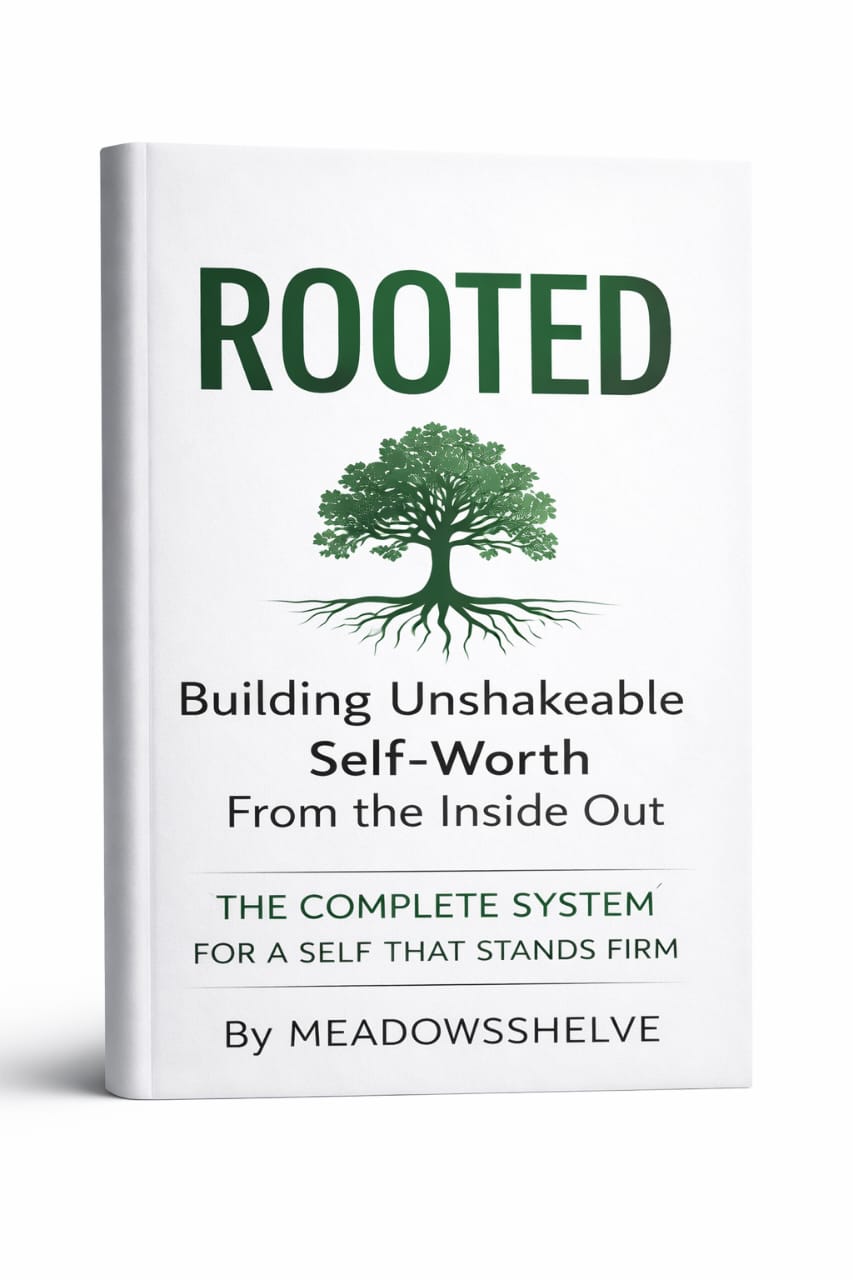
The full system for reclaiming that power is inside Rooted: Building Unshakeable Self-Worth From the Inside Out.